“We are at the forefront” – Circular economy expertise and technology are Finland’s export assets

SUMMARY
- Recycling materials is essential as natural resources become scarcer, and by-products can be refined into new, commercially viable products.
- In terms of the circular economy, LAB’s expertise covers, among other things, side streams of food production, bio-based materials and the utilisation of carbon dioxide.
- The side streams of the food and forest industry have great untapped potential, such as oat hulls, spent grains and wood fibre fractions.
- The circular economy strengthens self-sufficiency and security of supply, when fossil-based or imported materials are replaced by domestic recycled solutions.
- Carbon capture and utilisation are emerging sectors in the circular economy where Finland is already at the forefront.
- LAB supports companies through RDI activities and trains new experts, which strengthens circular economy expertise and technology export.
Every year, Finland reaches its Country Overshoot Day already early in the year. At that time, we have used our share of the natural resources of the year, and we operate in a direct ecological deficit for the rest of the year.
“The limits of the Earth’s carrying capacity are met a little earlier each year. No new resources or materials are coming to Earth, so we should recycle and make better use of the materials currently in use,” says Sami Luste, chief specialist at LAB.
Luste works as an expert in LAB's research, development and innovation (RDI) activities related to food industry side streams. Luste also has experience of other bio-based materials. Both are related to the multi-purpose materials identified as LAB’s strategic core strength.
“I examine how food production connects to the circular economy. We use circular economy competence to build a regional ecosystem and contribute to the transformation of the food system. The circular economy is a comprehensive and complex system. It requires a comprehensive overall picture so that development does not remain an optimisation of small areas. Our task at LAB is to consider this overall picture in our work,” says Luste.
One person’s waste is another person's value-added compound
In addition to the product itself, both the food industry and other productive industries almost always generate side streams, i.e. surplus raw materials and waste. For a large part of these, even waste, a new, profitable use or application may be found.
“For example, wastewater sludge is very nutrient-rich and contains a lot of value-added compounds that could be utilised in fertilisers, for example. However, there are still challenges in its utilisation, such as legislative barriers and concerns about potentially harmful substances,” says Annakaisa Elo, chief specialist leading LAB’s research group on bio-based materials.
Currently, most fertilisers used in Finnish agriculture are fossil-based. Indeed, the circular economy and the utilisation of various side streams are intertwined with improving the planet’s carrying capacity and the green transition in more ways than one. Various bio-based and recycled materials aim to replace, for example, new materials of fossil origin.
In addition, the circular economy can be seen from the perspective of self-sufficiency and security of supply. The more we can replace new materials with recycled materials and materials refined from our industries’ side streams, the better we guarantee our self-sufficiency.
“For companies, the utilisation of side streams and waste may also be financially viable. In addition to creating added value from side streams, it is often expensive to dispose of them,” says Elo.
Biofine studies the full utilisation of wood
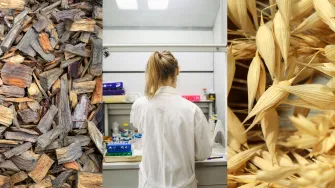
According to Elo, one example of a bio-based industrial side stream that is not yet very well utilised is wood. Currently, only a small proportion of the wood used by the forest industry is used in the product itself. Most of the wood is burned.
“In Finland, a large proportion of bio-based materials are based on wood, and increasing investments are made in the industry that utilises it. However, it is clear that we cannot keep cutting down forests indefinitely. Therefore, we need to utilise the wood used more efficiently.”
LAB studies and develops the separation and refining of forest industry side streams and other fibre-based materials into, for example, binders and vitamins in the extensive Biofine project, under which a multi-optimised biorefinery will be opened in Lappeenranta in 2026. The project is linked to the strong pulp and paper industry in South Karelia.
Lahti makes xylitol out of oat hulls
LAB’s Lahti campus focuses on the food industry which is strong in the Päijät-Häme region. The campus is home to the Food Pilot Plant, a development environment for plant-based products, and LAB is also involved in the newly established Food Campus Finland, which will build a national and international collaborative platform for food exports.
“Oats are an important product in this area, so we focus, among other things, on making better use of its properties in processing and end products. A good example of this is the xylitol Fazer produces from oat hulls. The Hartwall spent grain mash is also a great example of the grain cycle, which allows the company to produce energy for its own use and fertiliser to produce new raw material crops. And all this happens within a few kilometres,” says Sami Luste.
Luste also highlights the new engineering training in biomaterials and food technology, beginning in autumn 2025. In addition to supporting companies’ RDI activities in many ways, LAB will also educate new experts for the needs of companies in the future.
Finnish circular economy competence is world class
Much remains to be done in the food sector’s circular economy mindset and in turning waste into resources. The ideal situation would be that everything that has previously ended up in compost could be used as food.
“One specific ingredient with a lot of room for development is fish. Fish side streams are rich in valuable fats and food material that has not yet been sufficiently productised,” says Luste.
However, Luste is aware that a perfectly closed-loop circular economy is practically a utopia, regardless of the sector.
"But aiming for it will at least point us in the right direction.”
Annakaisa Elo highlights the circular economy, which aims for carbon dioxide sequestration, as an important development area. Carbon dioxide is used as a raw material in a number of industries where it can be used in products instead of being stored, for example, under the seabed.
Carbon capture and utilisation is studied and developed in the Hiiliketju (Carbon Chain) project coordinated by LAB. Carbonaide, a company operating in the Lahti region, already produces concrete that stores carbon dioxide.
“Finland has excellent expertise in the treatment of bio-based side streams and wastewaters, as well as carbon sequestration. We are pioneers, and we should also be able to utilise it in the export of both technology and expertise. Here, the green transition offers us a significant opportunity,” says Elo.
More information:
 lab [dot] filab [dot] fi