
Finnish oat products can be the next export asset for gluten-free products

A gluten-free diet is trending, which is why gluten-free baking has also risen from the margin to the mainstream. According to an estimate by the Finnish Coeliac Society, at least 150,000 Finns follow a gluten-free diet, even though only about 40,000 Finns have been diagnosed with coeliac disease.
Along with the gluten-free market, consumer expectations of product quality have also increased. This poses challenges especially to the development of bakery products. Gluten-free bread lacks gluten, so it also lacks elasticity. The elasticity, which comes from the gluten-network, improves the gas-holding capacity of the dough, makes the wheat bread soft and airy, as well as improves the preservation of the bread structure.
“Gluten-free bread often has a sandy mouthfeel. Because gluten-free bread is often made from, for example, rice flour or maize starch, their fibre content is also usually low and their nutritional content is poor,” explains Saara Sammalisto, researcher at the LAB Food Pilot Plant.
The quality of gluten-free bread can be enhanced with hydrocolloids
Naturally gluten-free oats are a promising raw material for gluten-free baking, but their use is still challenging. There is little research on the topic, so the functional properties of oats are not yet well known. In addition, oat doughs are often sticky and difficult to handle.
A solution to the challenges of oats could be found in hydrocolloids. Hydrocolloids are water-binding compounds used in foods to produce structure. In gluten-free baking, they bind water, make the dough easier to handle and help the bread to rise.
In their doctoral dissertation and at the LAB Food Pilot Plant, LAB Researcher Saara Sammalisto has studied which hydrocolloids work best in 100% oat baking.
The most appropriate hydrocolloid depends on the cereal raw material and its quality
There is no previous comparative study on commercial hydrocolloids suitable for gluten-free oat baking. Typical gluten-free baking hydrocolloids in commercial use include psyllium, xanthan and cellulose derivatives. In addition, polysaccharides in linseed bind water and provide structure to the dough.
Typically, studies on gluten-free baking have been conducted using rice and/or maize flours or starches, which are far from oats in terms of their properties. This makes it difficult to say which hydrocolloid or hydrocolloid combinations would work best in which situations.
“Our study shows that the efficacy of hydrocolloids in oat baking varies greatly, also between different oat flours. The combined effects of the oat’s natural beta-glucan and the added hydrocolloids should be studied in more detail,” says Sammalisto.
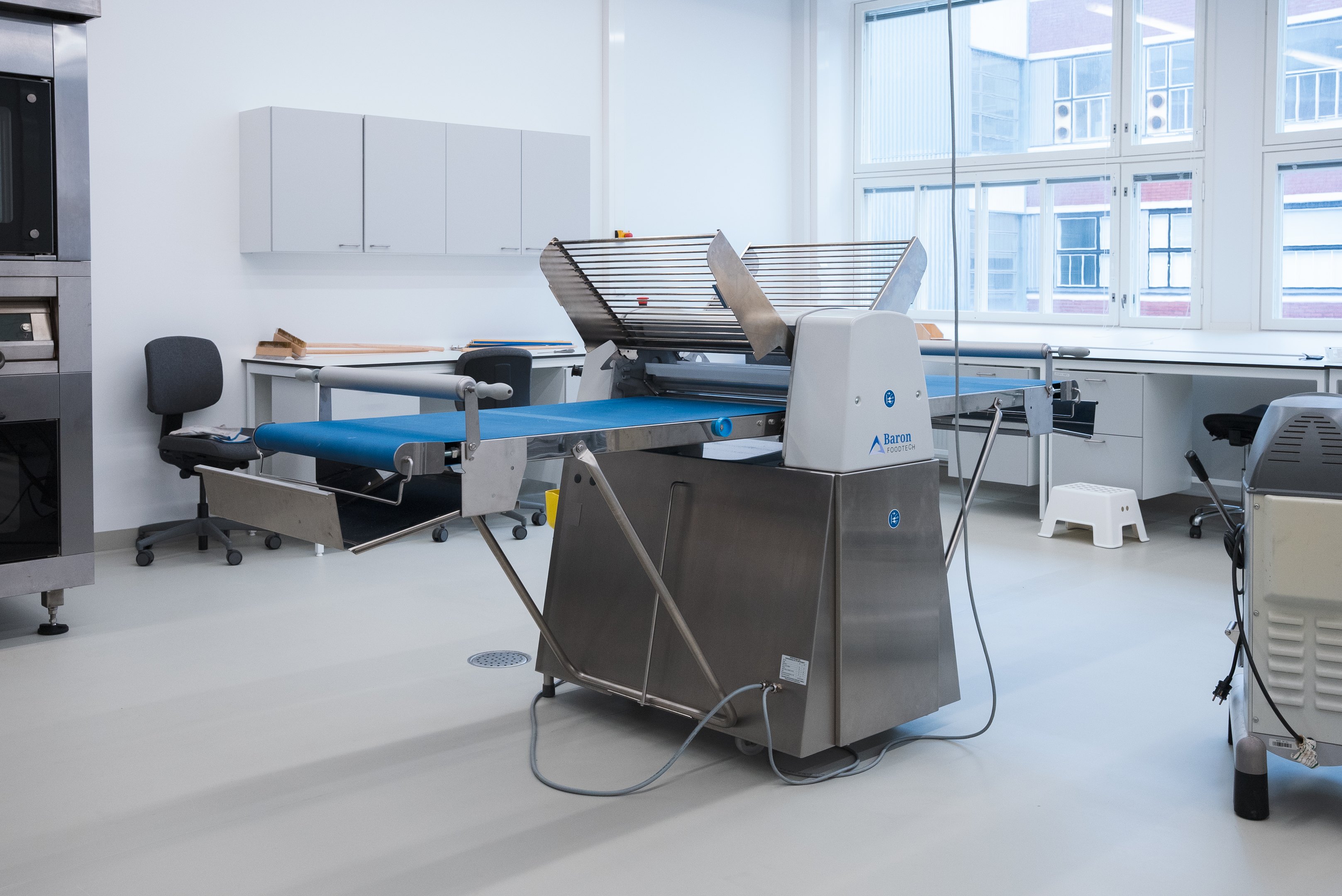
Research device at LAB Food Pilot Plant.
Oats are healthy, tasty and give the bread a good structure
The inherent properties of oats make them a promising raw material. In addition to being gluten-free, it is of high nutritional quality and its dietary fibre binds water well. Several health claims have also been approved for oats dietary fibre (beta-glucan).
Whole grain oat bread also remains soft and has a pleasant structure and taste. When using endosperm flours produced from oat groats, it is possible to obtain more airy structures for the bread. In addition, beta-glucan isolated from oats has been shown to function as a hydrocolloid. In oats, the hydrocolloid is thus built in.
”Oats are well-suited for cool growing conditions. In the North, oats have a long history of use in food, leading to the development of numerous diverse oat-based products, whereas in many other countries, oats have been considered as food for horses rather than humans. Finland is one of the leading countries in oat research.”
The export potential of oats is also widely recognised, as both gluten-free baking products and other processed oat-based products. For example, the recently published report by the Natural Resources Institute Finland (Luke) mentions gluten-free oat bread as a highly potential export product. In Finland, oats are also used in the manufacture of a wide range of substitutes for meat and dairy products, which is also special on a global scale.
At present, oats are exported from Finland mainly as grains.
“Product development and exports should focus specifically on high-valued-added products rather than grain exports. In addition, oat products can be associated with health claims regarding their cholesterol-lowering effects, the value of which may be significant in the marketing of products abroad. If people were more aware of the health benefits of oats, would their demand and use also increase abroad?” Sammalisto asks.
Additional research would further enhance the quality of gluten-free bread
For decades, those following a gluten-free diet have had to settle for bread and pastries whose quality falls far short of wheat-based breads. With the use of hydrocolloids and oat baking research, the challenges are gradually turning into opportunities for which the Finnish food industry has a major advantage.
Finland already knows how to produce good gluten-free bakery products. However, more systematic research is needed to achieve the export potential of gluten-free oat bread and to facilitate the use of oats in gluten-free baking. Oat baking can enable a category of gluten-free products, where compromises in terms of nutritional quality and product structure remain small.
“Although gluten-free bread can hardly ever achieve the same result as wheat-based baked goods, the quality of commercial products has already improved considerably. Through research, the challenges of gluten-free oat baking can certainly be solved. Research has already shown that oat bread can achieve a very high quality when the oats’ raw material quality and hydrocolloids are known,” says Sammalisto.
More information:
 lab [dot] fi

