



Human well-being
DETECT 2.0 Deep Tech Competence Enhancement for the Digital Transition and Challenges in Dementia Care

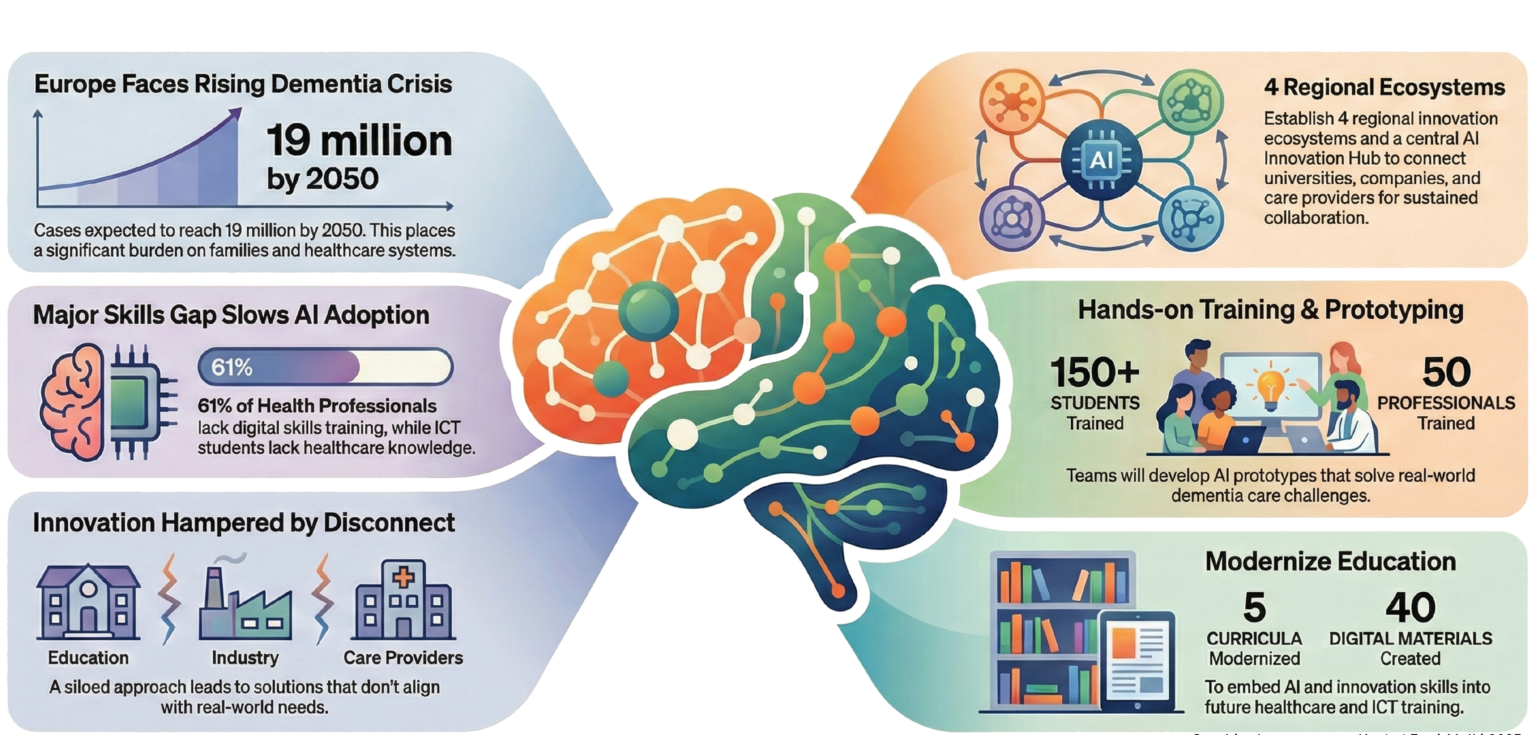
The DETECT 2.0 project fosters AI-driven innovation to enhance the independence and quality of life for people with mild cognitive impairment (MCI) and early-stage dementia. By equipping healthcare and ICT students in HE and VET with AI related knowledge and human centric innovation skills, it ensures future professionals capability to develop and apply ethical, patient-centered technology in dementia care. DETECT 2.0 also increases awareness about AI’s potential among professionals in dementia care, ensuring better adoption of new technologies.
With a collaborative innovation ecosystem approach, DETECT 2.0 integrates healthcare organizations, AI companies, educators, and researchers, and strengthens regional AI innovation ecosystems, boosting economic vitality, future workforce development and driving sustainable healthcare transformation to a green economy. It leverages European expertise to address the growing burden of dementia, empowering future healthcare and ICT professionals to develop responsible AI solutions.
Through renewed HE and VET education and educational materials DETECT 2.0 strengthens innovation capacity, digital and entrepreneurial skills, and collaborative networks, and thus shapes the future workforce, ensuring lasting impact on dementia care and healthcare digitalization in Europe.
With a collaborative innovation ecosystem approach, DETECT 2.0 integrates healthcare organizations, AI companies, educators, and researchers, and strengthens regional AI innovation ecosystems, boosting economic vitality, future workforce development and driving sustainable healthcare transformation to a green economy. It leverages European expertise to address the growing burden of dementia, empowering future healthcare and ICT professionals to develop responsible AI solutions.
Through renewed HE and VET education and educational materials DETECT 2.0 strengthens innovation capacity, digital and entrepreneurial skills, and collaborative networks, and thus shapes the future workforce, ensuring lasting impact on dementia care and healthcare digitalization in Europe.


Bridging the AI Skills Gap in Healthcare and ICT Education
European curriculum analysis found that AI and AI-based dementia care solutions are still insufficiently covered in healthcare and ICT education. The findings highlight the need for stronger interdisciplinary training that combines healthcare, AI, innovation, and entrepreneurship competencies.
Basic information
Project manager
Pirjo Tuusjärvi
RDI specialist
pirjo [dot] tuusjarvi lab [dot] fi
lab [dot] fiMore information about the project
Project state
On-going
Implementation area
International
LAB role
Lead partner
Unit
Health Care and Social Services
Key competence
Human well-being