

Human well-being
NEAR - NEw sociAl seRvices: innovative tools and skills for person-centred and community-based social models

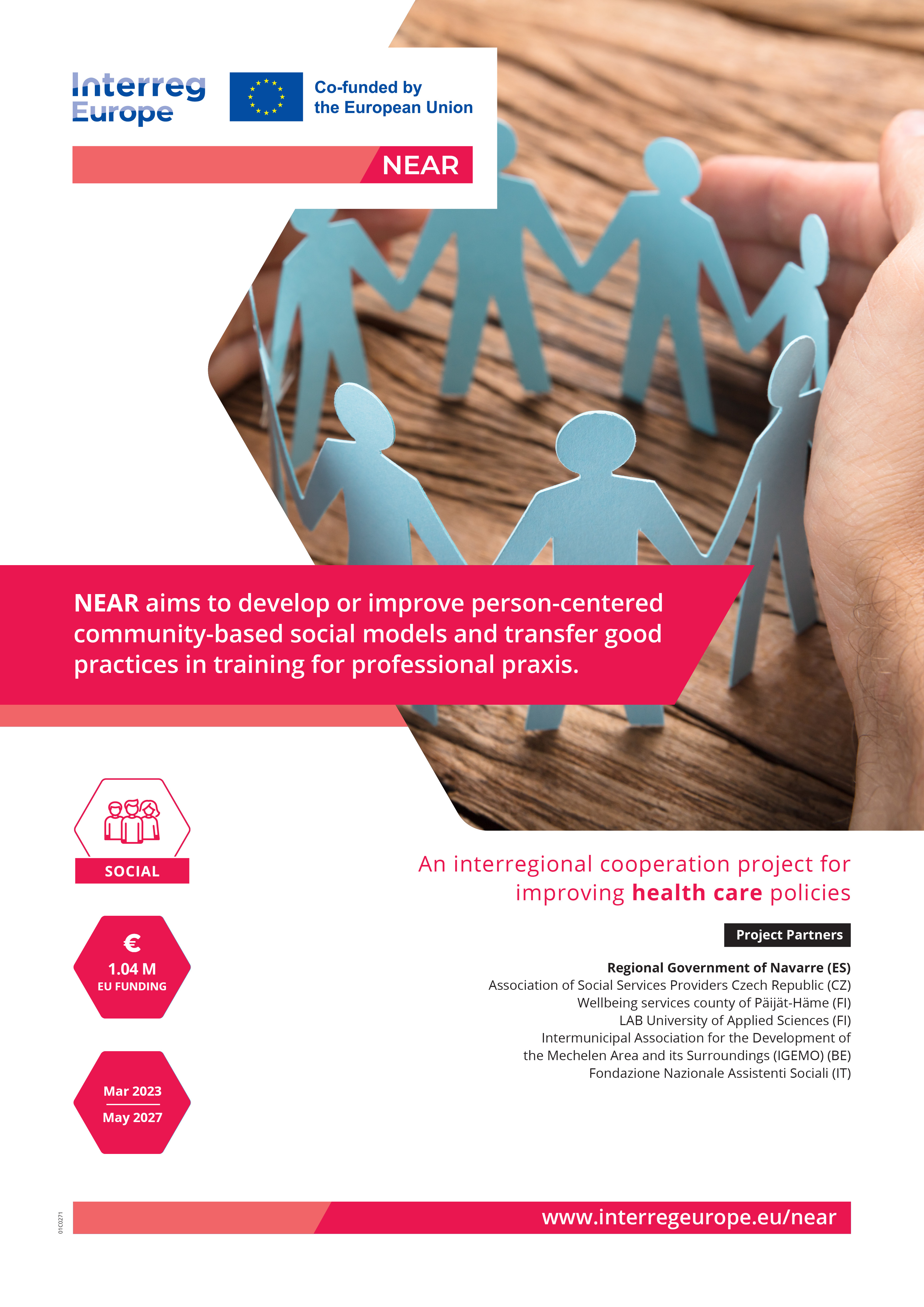
The NEAR (NEw sociAl seRvices) project will be implemented in 2023-2026. The project has been funded by the European Union’s Interreg Europe programme. The project operates on two levels: at the regional level in Päijät-Häme and at the international level with the partner regions. The project’s lead partner is from Spain. In addition, partners from Italy, Belgium, the Czech Republic and Finland are involved, including LAB University of Applied Sciences and Wellbeing Services County of Päijät-Häme.
The project focuses on sharing person-centred and community-based good practices in social services. The participating regions identify effective working methods and share them with partner regions. At the same time, they identify the skills that professionals need in order to apply these approaches. The project also includes study visits, staff exchanges, local cooperation and influencing regional policy programmes. In Päijät-Häme, the aim is to develop the wellbeing services county’s participation programme and support its implementation.
The project is based on an person-centred and community-oriented approach that emphasises individuality, holistic support, and the importance of close relationships and the wider community in client work. Community resources and strengths can be used to support the agency of individuals, while individuals also have strengths that benefit their communities. This approach requires changes in professional practices in social work and in the role of social service professionals.
In Päijät-Häme, the project operates in cooperation with a stakeholder group composed of representatives from the LAB UAS, Wellbeing services county of Päijät-Häme, the City of Lahti and local NGOs. The stakeholder group also participates in the international cooperation activities.
The project focuses on sharing person-centred and community-based good practices in social services. The participating regions identify effective working methods and share them with partner regions. At the same time, they identify the skills that professionals need in order to apply these approaches. The project also includes study visits, staff exchanges, local cooperation and influencing regional policy programmes. In Päijät-Häme, the aim is to develop the wellbeing services county’s participation programme and support its implementation.
The project is based on an person-centred and community-oriented approach that emphasises individuality, holistic support, and the importance of close relationships and the wider community in client work. Community resources and strengths can be used to support the agency of individuals, while individuals also have strengths that benefit their communities. This approach requires changes in professional practices in social work and in the role of social service professionals.
In Päijät-Häme, the project operates in cooperation with a stakeholder group composed of representatives from the LAB UAS, Wellbeing services county of Päijät-Häme, the City of Lahti and local NGOs. The stakeholder group also participates in the international cooperation activities.
More information about the project
About the project

Good practices
The Interreg Europe Policy Learning Platform has published good practices identified in the NEAR project.

Article: Professional skills for the new social services
Social services need to adopt a model of care based on both person-centered and integrated approach. The model change must be accompanied by a change in professional praxis, moving from a role of expert to one of accompaniment, support, guidance and motivation, giving a new role to service users. In Päijät-Häme, professional skills crucial for person-centered and community-based models have also been identified. This article discusses these skills and the process of identifying them.

Article: Towards person-centered and community-based social services in the Päijät-Häme region
A person-centered and community-based approach can help social services to be more integrated and holistic by reducing gaps in the social service system, meeting the needs of people in vulnerable situations, and thus making the services more effective. Approach is already more or less adopted at least in some parts of the social service system in Päijät-Häme, but it still has more to offer for the development of social services in the region.
Projektipäällikkö
Outi Jokinen
RDI specialist
outi [dot] jokinen lab [dot] fi
lab [dot] fiMore information about the project
Project state
On-going
Project area
International
LAB role
Partner
Unit
Health Care and Social Services
Key competence
Human well-being
Project partners